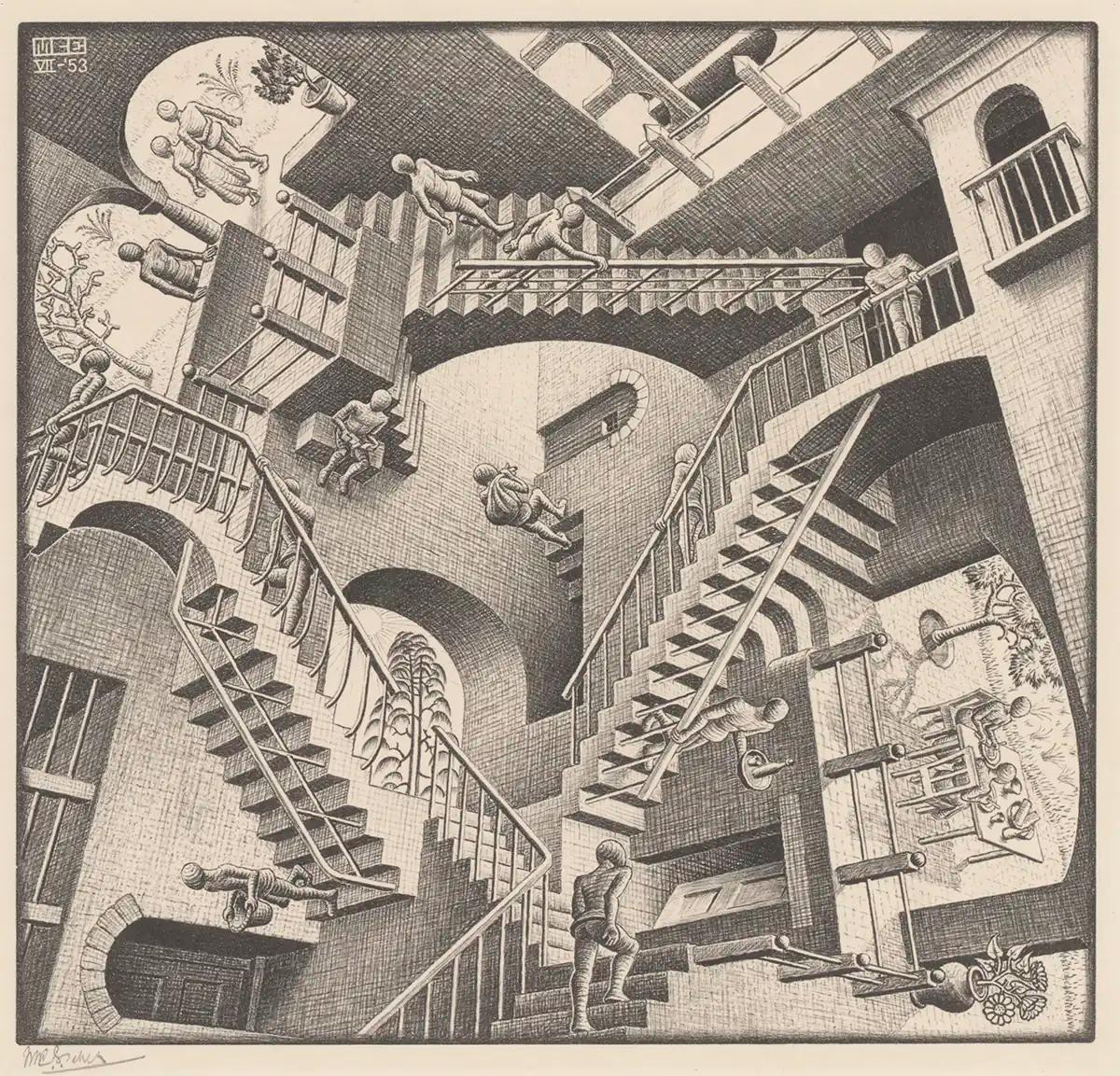
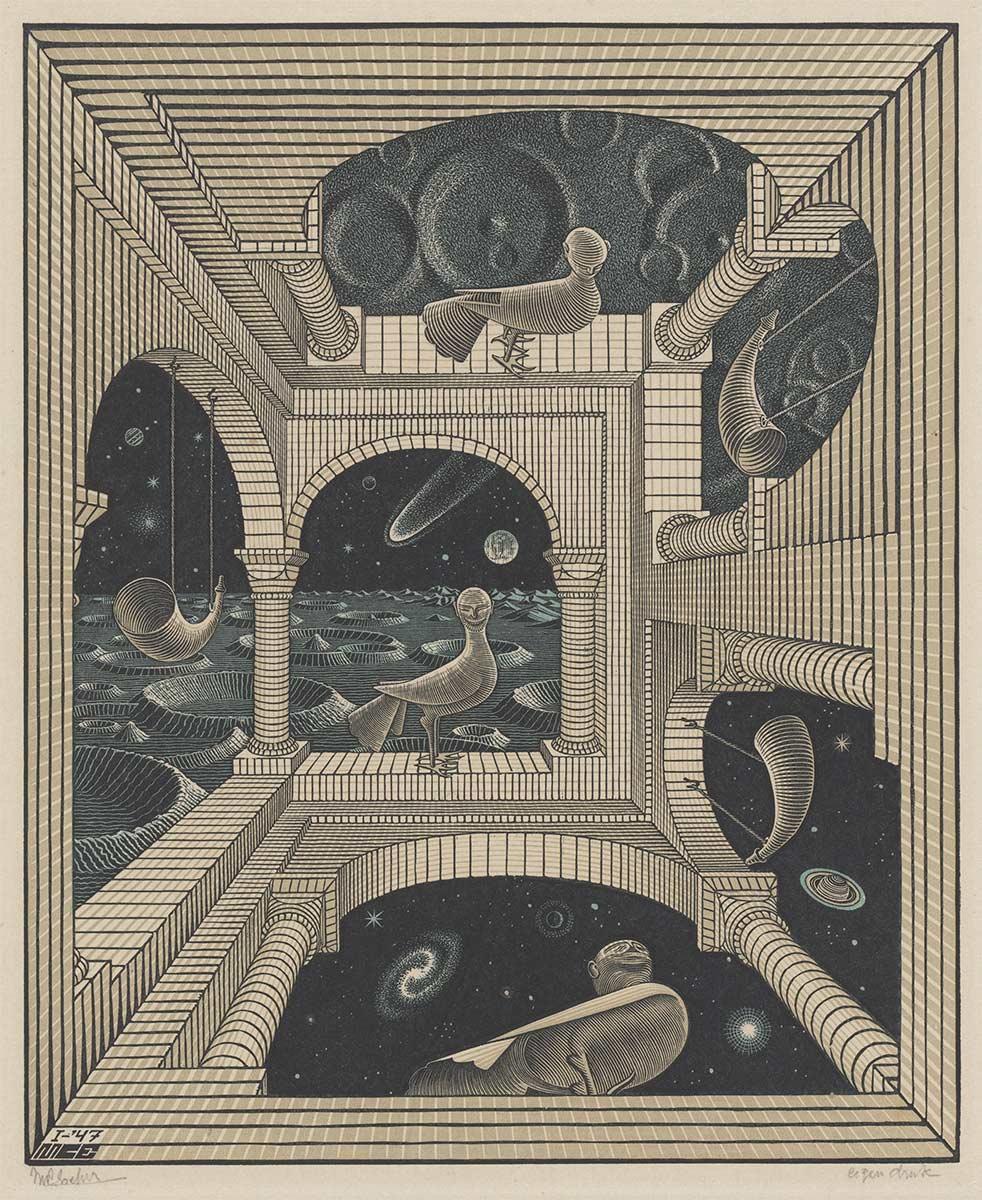
Escher’s fascination with the possibilities of perspective is already evident in early prints such as Tower of Babel (1928) and Inside St Peter’s (1935). In these works, he consistently applied the rules of classical perspective, although he did seek out extreme vantage points from which to depict his subjects. Later, he began to experiment more and used the rules of perspective to mislead viewers. Think of prints such as Other World (1947) and Relativity (1953).
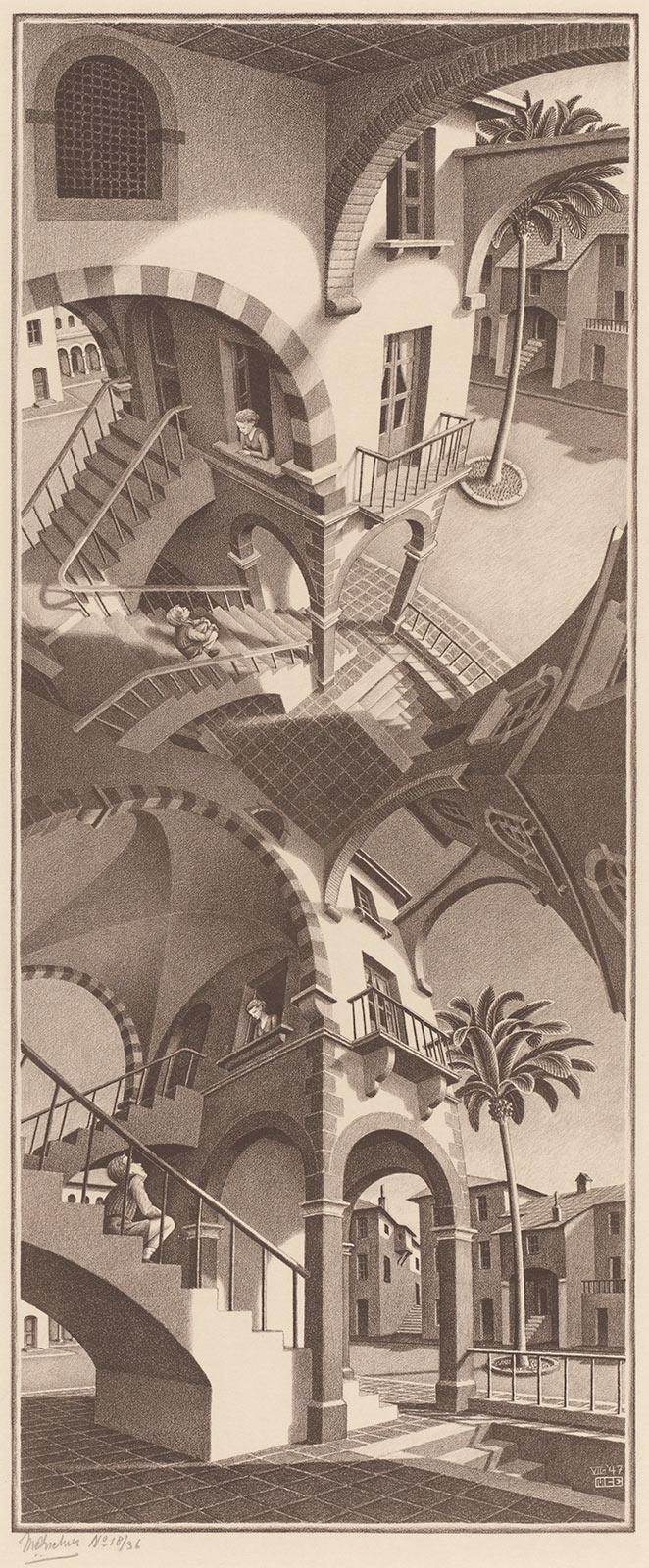
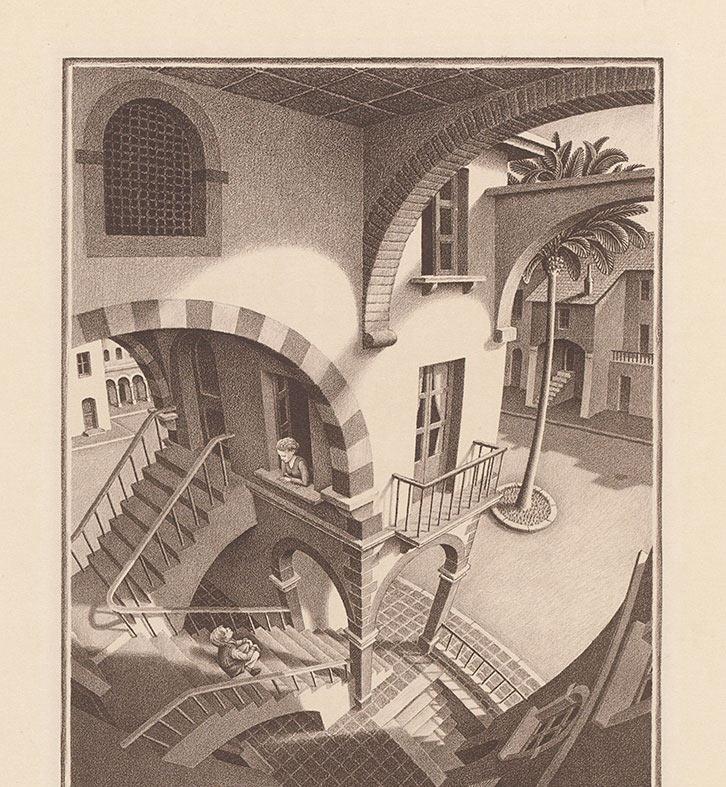
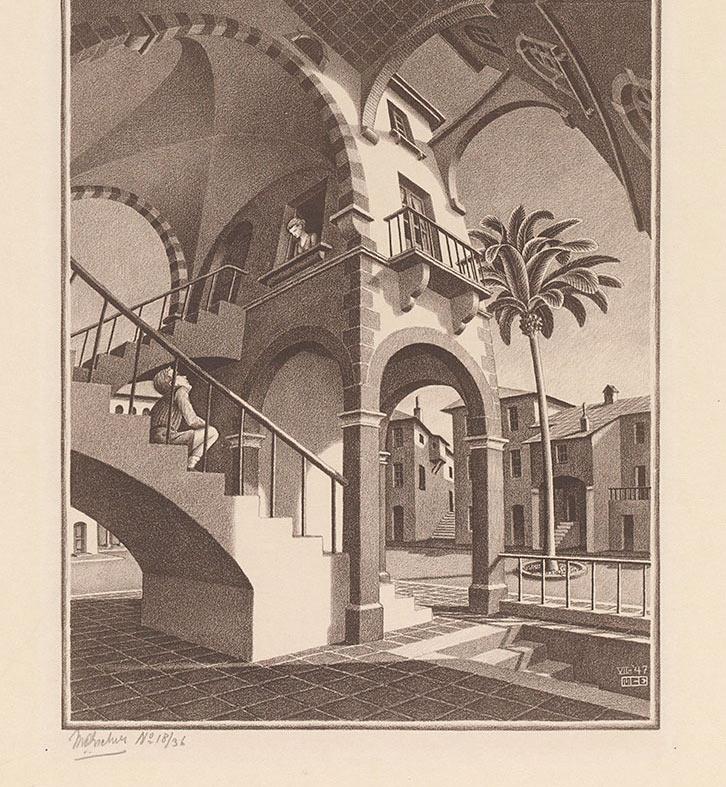
In these examples, the perspective lines are straight, but Escher realised that, in actuality, a curved line corresponds more closely to what our eyes see. This is because our eyes are always in motion, and a curved perspective is the best way to visualise this on paper. What is brilliant about Escher is that he uses this insight in a way that no one else does. The print Up and Down is the most successful example of this.

M.C. Escher, Other World, wood engraving and woodcut in black, reddish brown and green, printed from three blocks, January 1947

M.C. Escher, Relativity, lithograph, July 1953

M.C. Escher, Up and Down, lithograph, July 1947
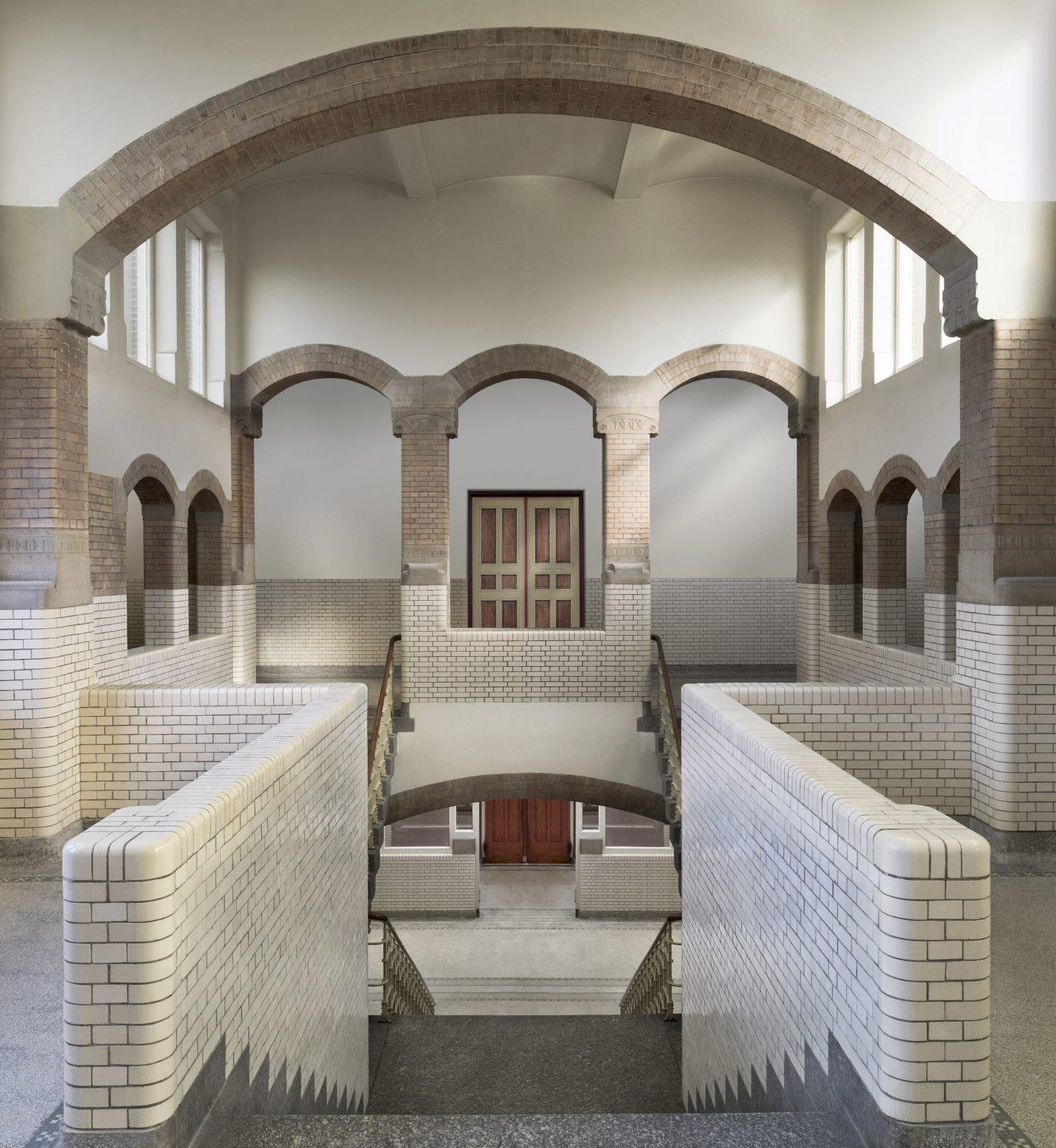
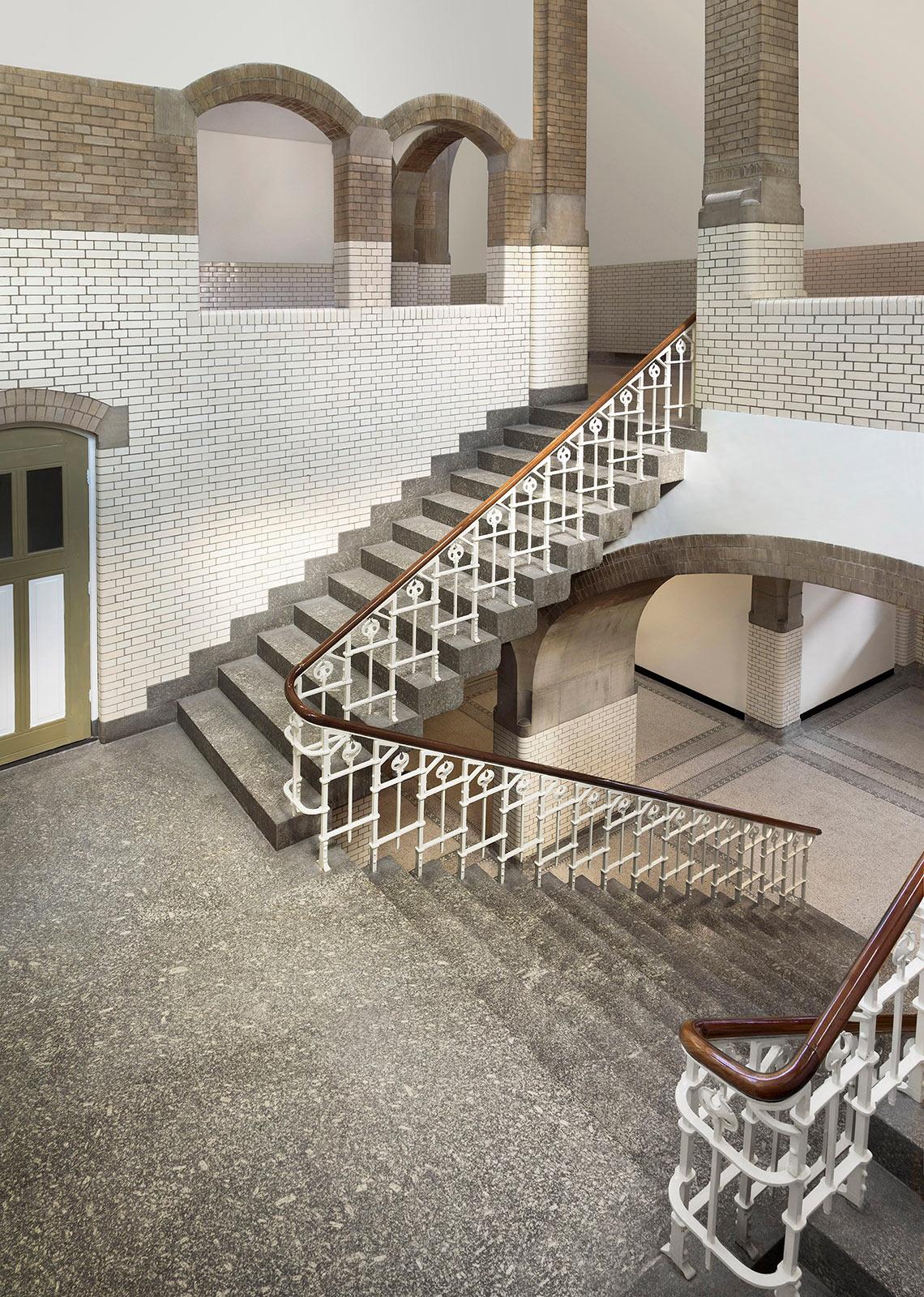
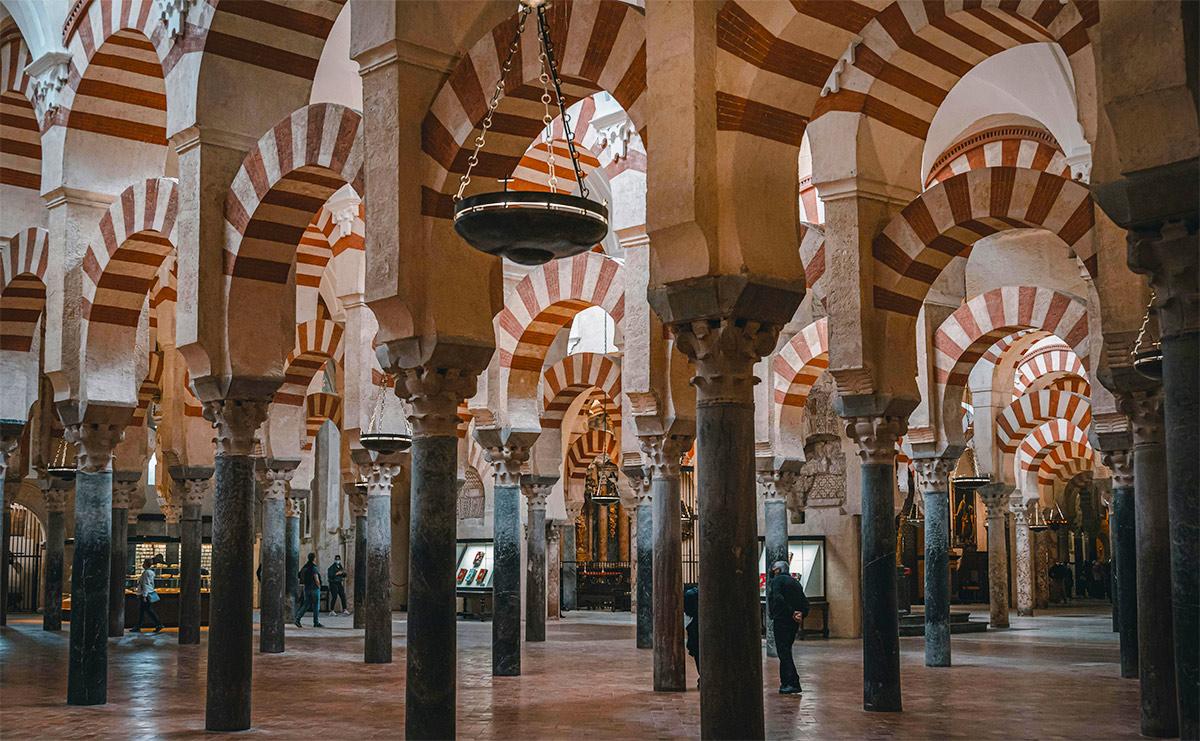
A striking feature of this architectural fantasy is the alternating stones in the arches, a detail strongly reminiscent of the characteristic arch structures of the Mezquita in Córdoba. There, the red and white arch stones create a rhythmic pattern that makes the arches appear lighter and lends depth to the space. This dynamic is subtly echoed in Escher’s architectural play. Round (‘Romanesque’) archways and windows also recur in other prints by Escher, such as Double Planetoid (Double Planet) (1949), House of Stairs (1951), Relativity, Convex and Concave (1955) and Other World. In these works, as well as in Up and Down, staircases play an important role. The source of this can be traced back to Escher’s secondary school days in Arnhem. From 1912 to 1918, he attended the HBS on the Schoolstraat. In the stairwell in the central part of the school building, dating from 1905, many elements can be seen that recur in all these prints.

Impression of view of the stairwell at HBS Arnhem, 1913. Photo: Studio Gerrit Schreurs, 2014.


The Mezquita in Córdoba
Although he had no fond memories of his years at the HBS, in 1947 he created a commemorative plaque for the school, in memory of the pupils and former pupils who had lost their lives during the Second World War. There is no evidence, but it is plausible that Escher also visited the school during that period. On that visit, he saw the striking windows and passageways and the distinctive staircase again, which must have stirred something within him. In fact, it might have inspired him rather immediately, as Other World dates from January 1947. Up and Down followed in July, where he took his journey into perspective another step further.

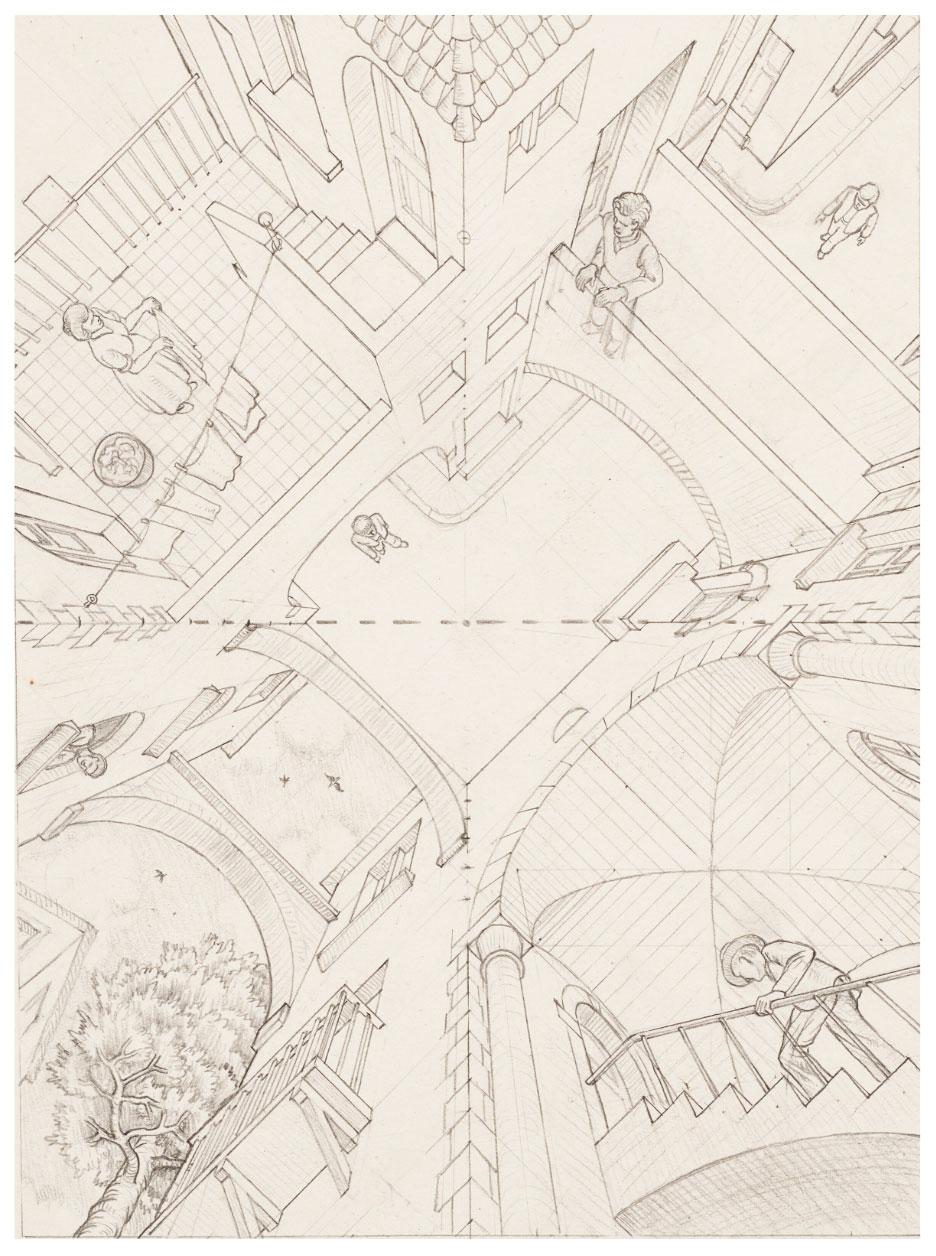
M.C. Escher, study for Up and Down, pencil on paper, 1947. Source: Christie’s auction #24220 (8–22 July 2025)

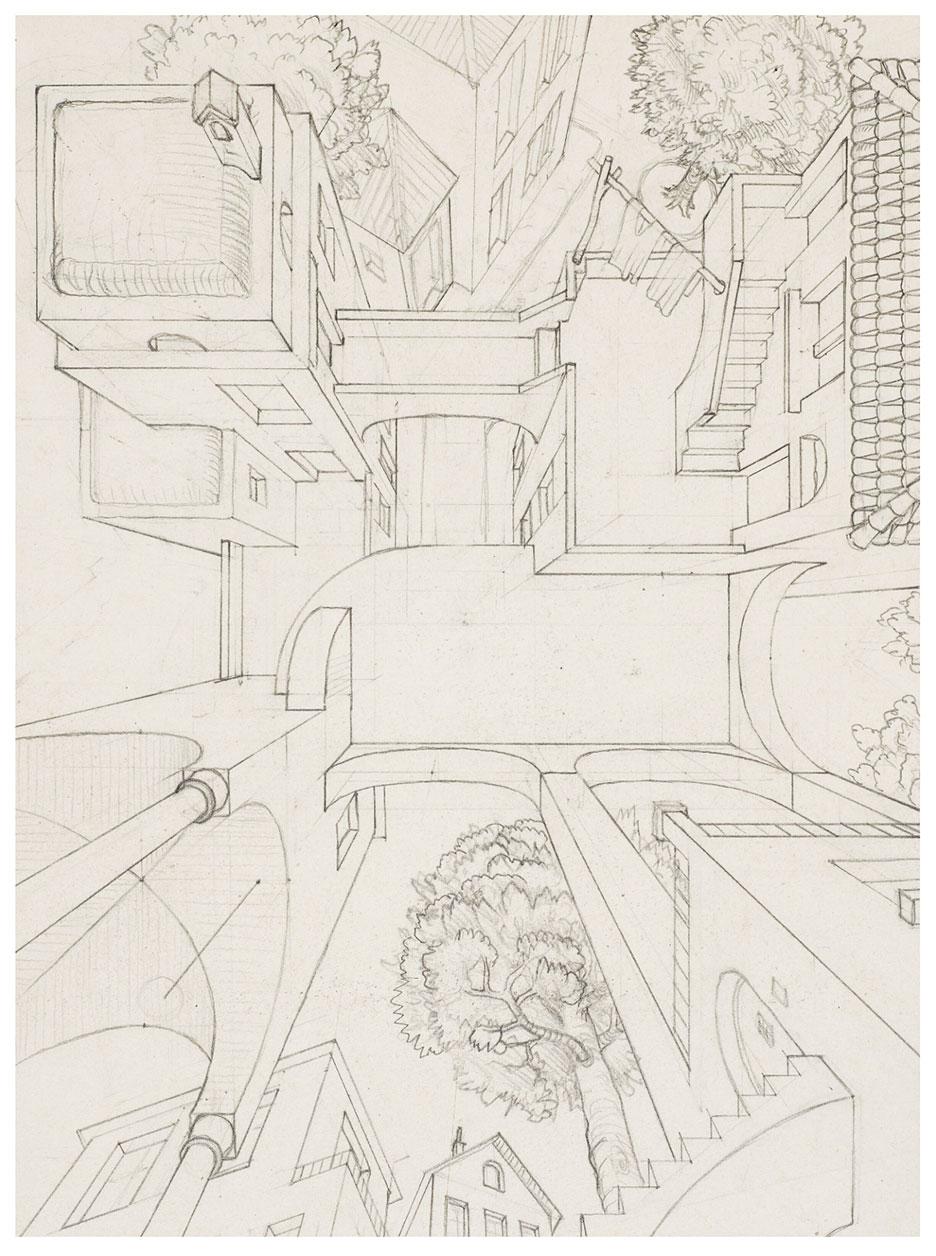
M.C. Escher, study for Up and Down, pencil on paper, 1947. Source: Christie’s auction #24220 (8–22 July 2025)
This is not to say that it was a simple task to make clever use of curved perspective. This first required an intermediate step: Escher produced two pencil studies in which he used straight perspective lines to create an impossible image. In these studies, he combines the vanishing point directly beneath you (the nadir, an extremely high angle) or the point directly above you (the zenith, an extremely low angle) with a straight-ahead view. They are, in fact, variations on Other World. In the centre, the perspectives intersect, rendering the image impossible. In a third study, he combines two different buildings in which the impossible point in the centre is a narrow street or (depending on your viewpoint) the sky. In this third study (in private collection), he introduces curved perspective lines. This makes the transition from a straight-ahead perspective to the nadir or the zenith much smoother, and your eyes begin to believe that this could exist in reality.
However, he realised that it made more sense to create a single building that could be experienced from two different viewpoints. The second stroke of genius was to have the central point fulfil two functions at once: ceiling and floor. In the final print, Up and Down, the nadir and the zenith converge in one and the same building, with both appearing twice. Thanks to the curved perspective lines, he repeats elements – such as windows, columns or a staircase – without becoming repetitive: the same element looks very different from the nadir than it does from the zenith.
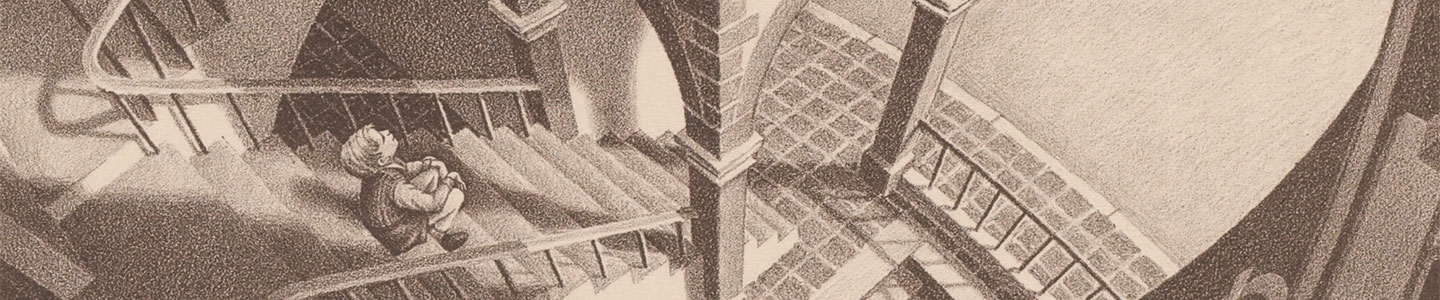
Escher does this so ingeniously that it only becomes apparent at second glance that the final image is impossible. The best way to illustrate this is by covering the top or bottom half of the work. You will then see a tower with windows, a balcony and a staircase. On the staircase sits a boy looking up at a girl in the window above him. Despite the extreme perspective, this is an image that your eyes can follow easily, although your gaze is strongly drawn either upwards or downwards. Depending on which half you choose to cover, all the perspective lines disappear into a tiled floor (the nadir) or a tiled ceiling (the zenith). Now remove the paper and you will realise that the tiles appear three times: at the bottom as a floor, at the top as a ceiling, and in the centre as both a ceiling and a floor. In between, Escher depicts the scene twice. However, from a different perspective, the top and bottom differ completely from one another. Yet he manages to create a coherent image. Although your eyes never truly find rest in this masterful print.