
Because of Escher’s father’s job as a civil engineer, the Escher family moved to the city of Arnhem in 1903, and took up residence at Utrechtsestraat 19. In 1912, Mauk entered the Lorentz HBS in the Schoolstraat. HBS schools were intended for upper middle class children. In an interview in 1968, Escher described his time at secondary school as the “Arnhem Hell”. He had to repeat the second grade, but fared slightly better the following year. Escher was not passionately interested in school. He devoted much of his time to drawing, and made extensive use of the spacious, light classroom at the front of the school building. Hand and line drawing were the only two subjects in which he achieved high marks consistently - eight of out ten. Escher befriended his arts teacher, F.W. van der Haagen, who advised him to study graphic design. This is where Mauk created his first linoleum cuts, although he refrained from making woodcuts.
Escher had a small group of friends at secondary school: brother and sister Jan and Fiet van der Does de Willebois, Conny Umbgrove, Roosje Ingen Housz and Bas Kist. Bas was studying at the Gymnasium. Bas and Escher met each other at the confirmation classes given by Mr Heering, a Minister at the Dutch Reformed Church (the Remonstrantse Gemeente). The five remained friends for life. With Conny, Bas and Roosje, he formed the youthful string quartet titled “Arnhem en Omstreken”. Mauk played cello. Roosje was his first love. She subsequently married Jan van der Does de Willebois.
Behind Escher's parental home in the Utrechtsestraat stood Stokvis, a munitions factory. During the First World War, the factory expanded massively. This generated a lot of noise and pollution. Eventually, Mauk's parents decide to move to the more rural environs of Oosterbeek. Situated on the corner of the Utrechtsestraat and the Beukenlaan, Villa Rosande was a spacious house with a large garden and an eye-catching tower with pointed roof. Mauk was the youngest son and the last to leave the parental home. He had a study on the top floor of the tower, where he, Bas and Jan read and discussed the works of Russian authors such as Dostoyevsky, Andrejev and Gogol, as well as Edgar Allen Poe. Literature, and in particular literature that explored the somber side of human existence and the inexplicable aspects of life.
Mauk and Bas also shared a great love of drawing. On 7 January 1917, they visited the painter Gert Stegeman (1858–1940), who had a studio with a printing press above the Sabelpoort in the centre of Arnhem, not far from the HBS. It was here that Escher learnt woodcarving. At home, he and his brothers had already been taught woodworking, so working with wood was nothing new to him. It was at Stegeman’s that Escher also produced his first etching: Railway Bridge over the Rhine at Oosterbeek. It is a small piece, 8.6 cm high and 12.3 cm wide. The print has been included in the exhibition not only because it has an unconventional perspective or because it is his first impression of nature, but because Escher kept all his early works. These initial interests can be seen time and again in Escher’s later development.
The bridge is not far from Villa Rosande; a beautiful, leafy avenue leads to the floodplains of the Rhine. On his walks through the area, he will have passed this spot many times. The current bridge was rebuilt in the same place after the Second World War. The bridge that Escher etched was blown up during the Battle of Arnhem.
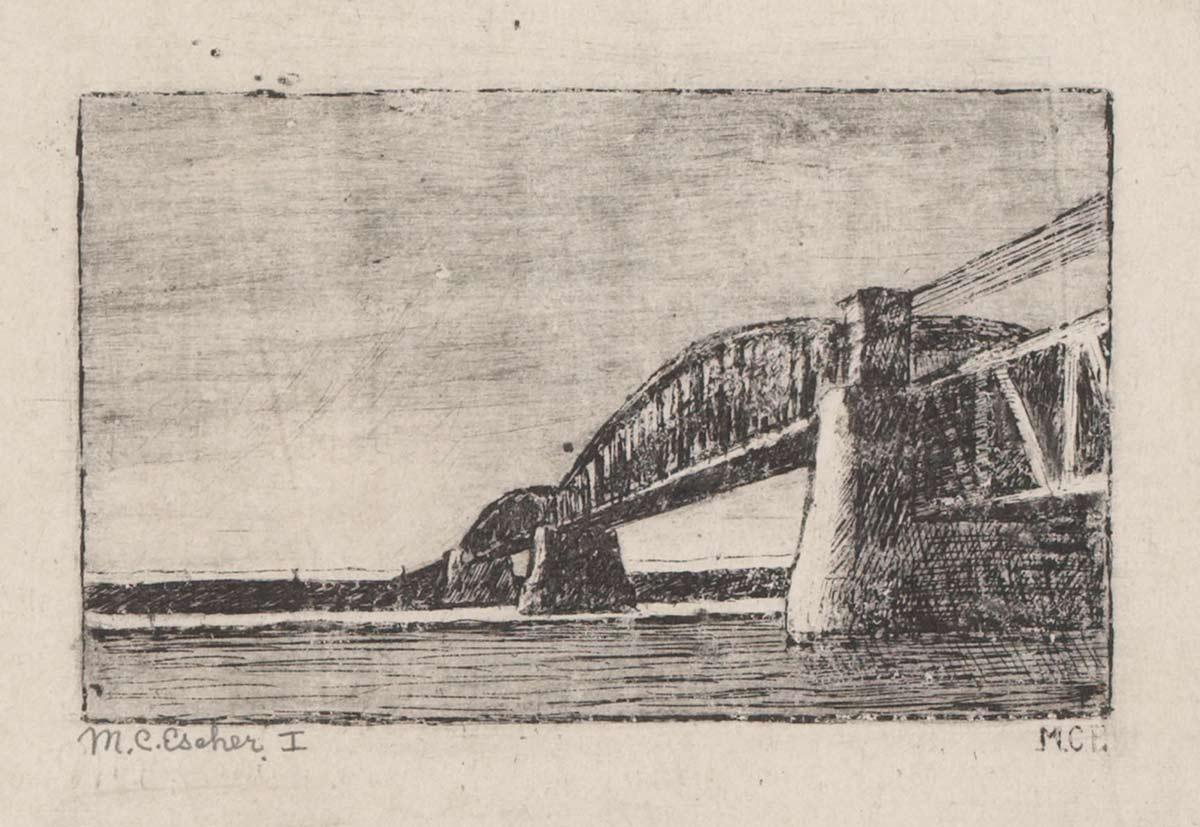
M.C. Escher, Railway Bridge over the Rhine at Oosterbeek, etching, 1917