
During his first visit, Escher carefully copied tile motifs he had seen in the Alhambra. This enabled him to study the technique behind such patterns at his leisure later on.** His second visit to Granada was a three-day trip with Jetta. They both sketched extensively whilst visiting the Alhambra and the Mezquita.
In the publication Visions of Symmetry, the American mathematician Doris Schattschneider examines the origins of Escher’s famous tessellations and explained how he used them. It provides a clear overview of when he created which drawings. This makes it almost possible to follow Escher’s train of thought and helps us understand what so captivated him as he walked through the Spanish-Islamic architectural sites in southern Spain.***
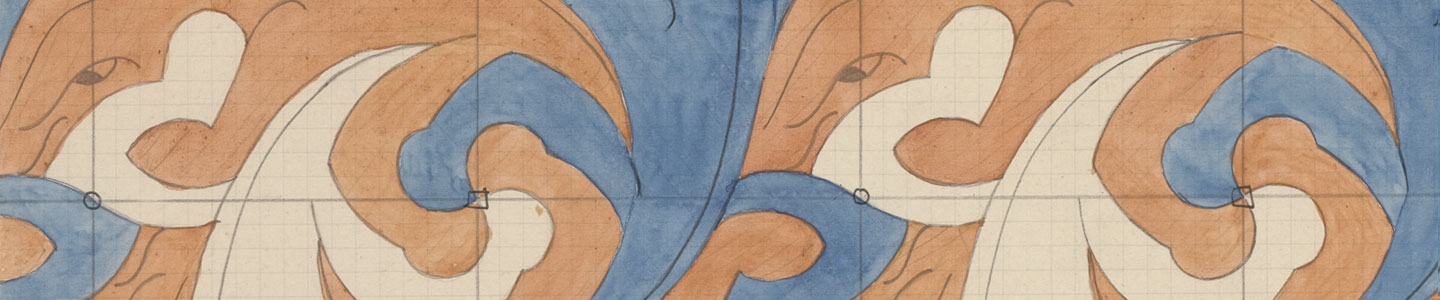
The work of M.C. Escher is well-known worldwide. Particularly for his optical illusions, such as Belvedere (1958) and Ascending and Descending (1960). However, what also defines Escher’s work are the numerous tessellations he created: patterns without overlap or empty spaces. While he starts creating never-ending patterns early in his career (e.g., Eight Heads, 1922), his fascination with infinity really takes off after his second visit to the Alhambra and the Mezquita (Andalusia) in 1936. Escher had already visited the Alhambra in 1922, but his second visit, together with Jetta Escher, would prove to be the most influential for Escher’s art practice.
What are the Alhambra and the Mezquita?
The Alhambra and the Mezquita are examples of Spanish-Islamic architecture in Andalusia, stemming from the historic Muslim communities that lived in the region. Cities such as Córdoba and Toledo were important centres of science, including medicine and mathematics, making southern Spain a key region where different cultures came into contact.
The Mezquita (also known as the Great Mosque) in Córdoba was built by Syrian migrants, modelled on the Umayyad Mosque in Damascus. Like its counterpart, the Mezquita is easily recognisable by its double row of horseshoe arches made of red and white stones. These arches also immediately inspired Escher. After seeing the ‘forest of columns’ in the Mezquita, he created his own version. For this drawing, he combined different perspectives, making the columns appear to stretch on indefinitely. When you visit the Mezquita, you will realise that the vantage point from which he made his drawing does not exist.
The Alhambra in Granada is the only major Islamic palace in Andalusia that has survived. The complex is characterised by understated exterior architecture and richly decorated interiors. The walls and ceilings are entirely covered with detailed mosaics, stucco calligraphy, and wood carvings.*
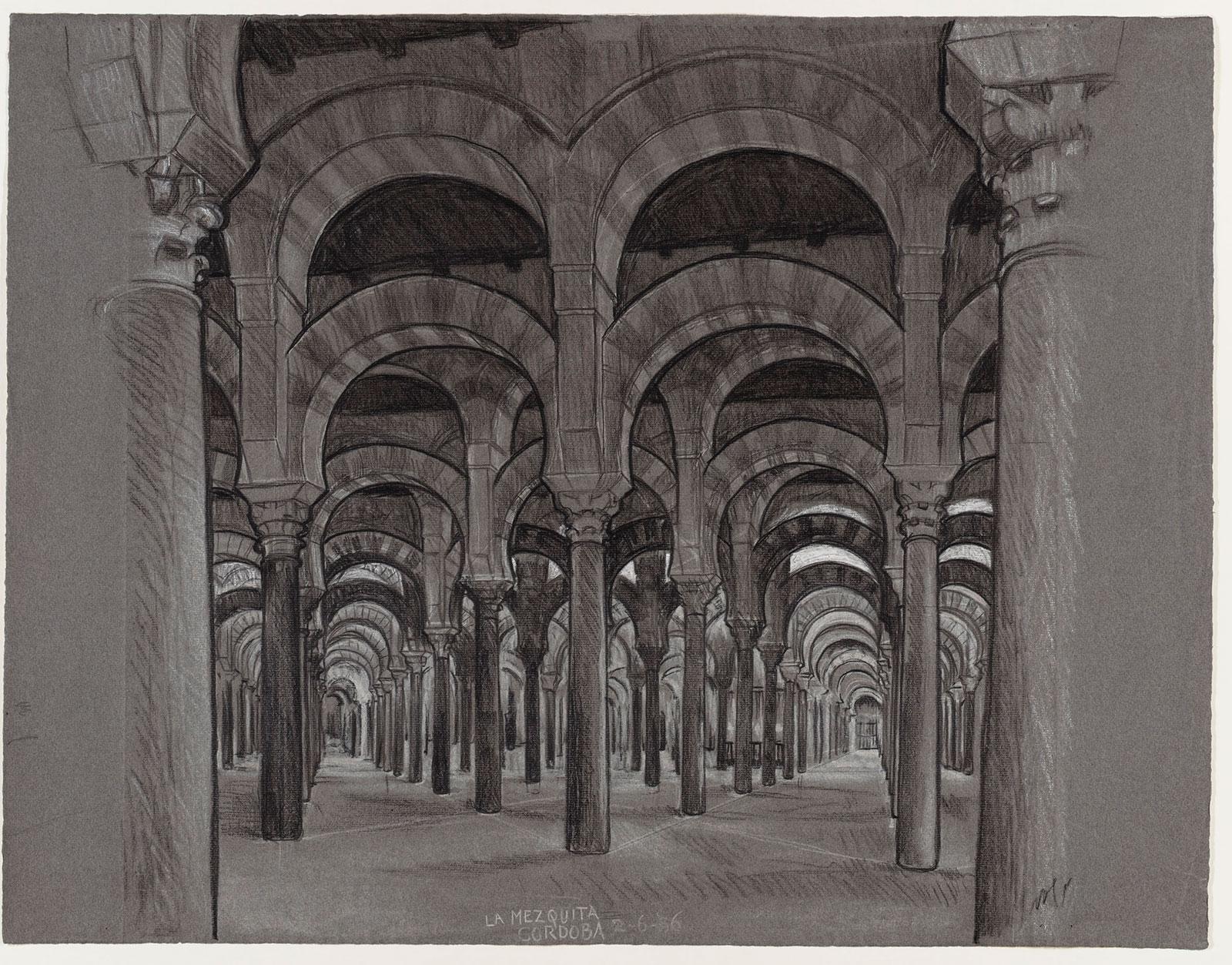
M.C. Escher, La Mezquita, Córdoba, black and white chalk, 1936
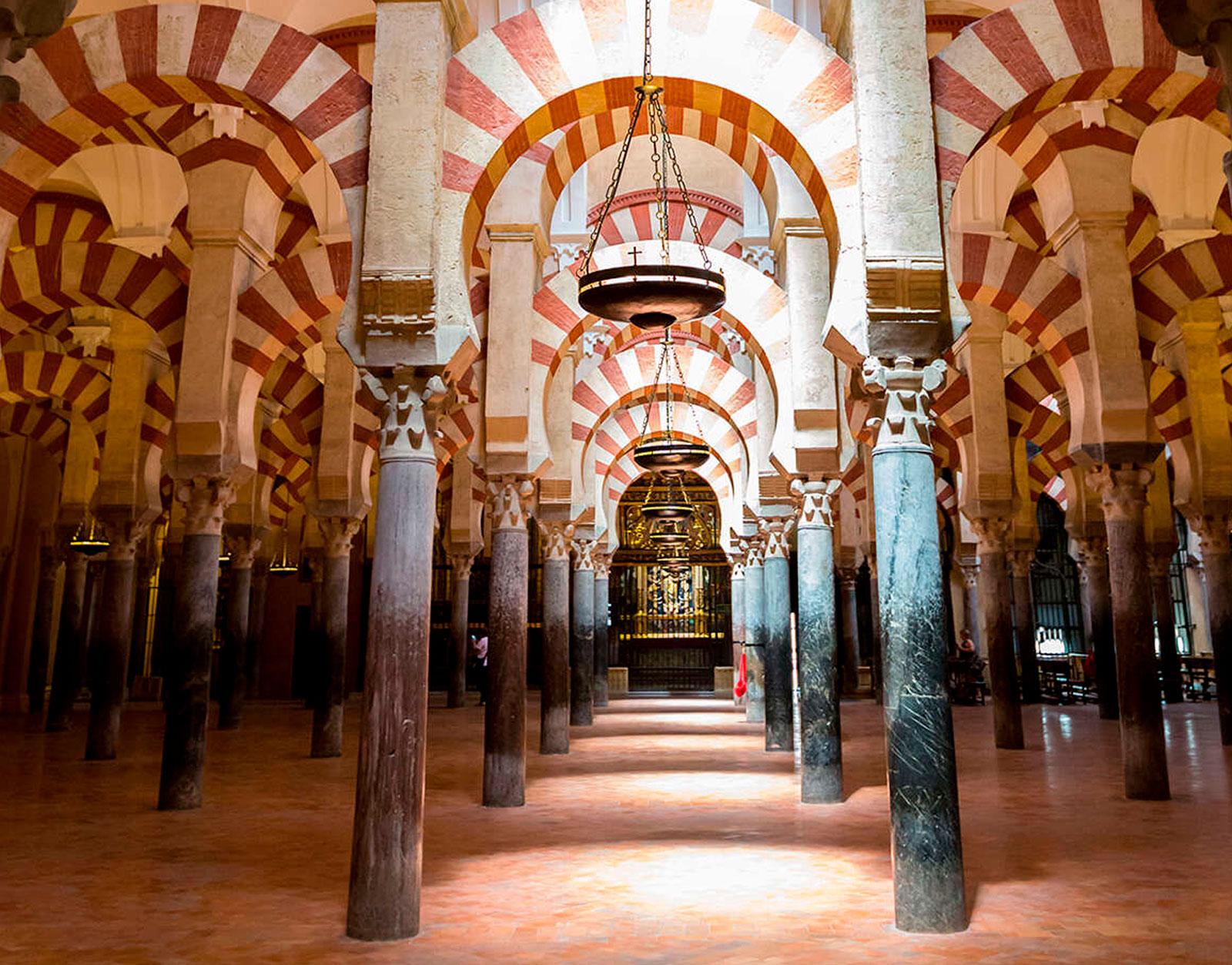
The 'forest of columns’ of the Mezquita in Córdoba
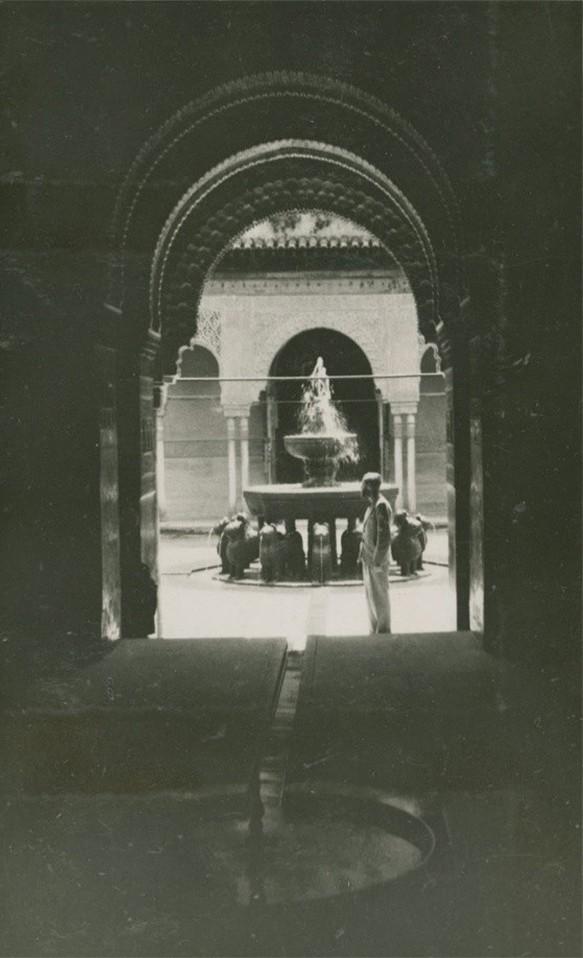
M.C. Escher at the Alhambra, 26 May 1936
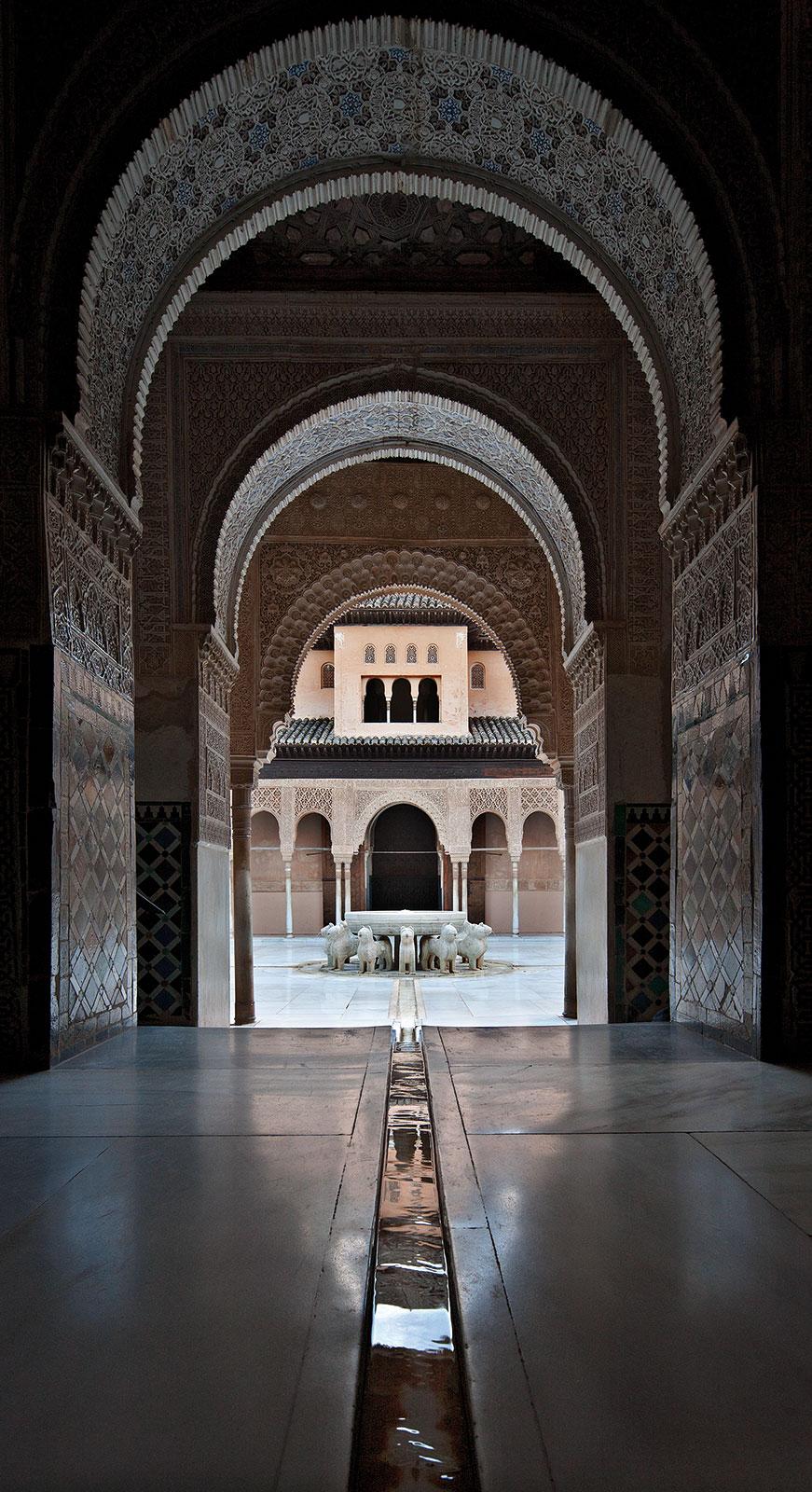
Pepe Navarro. Courtesy Archivo de la Alhambra y Generalife
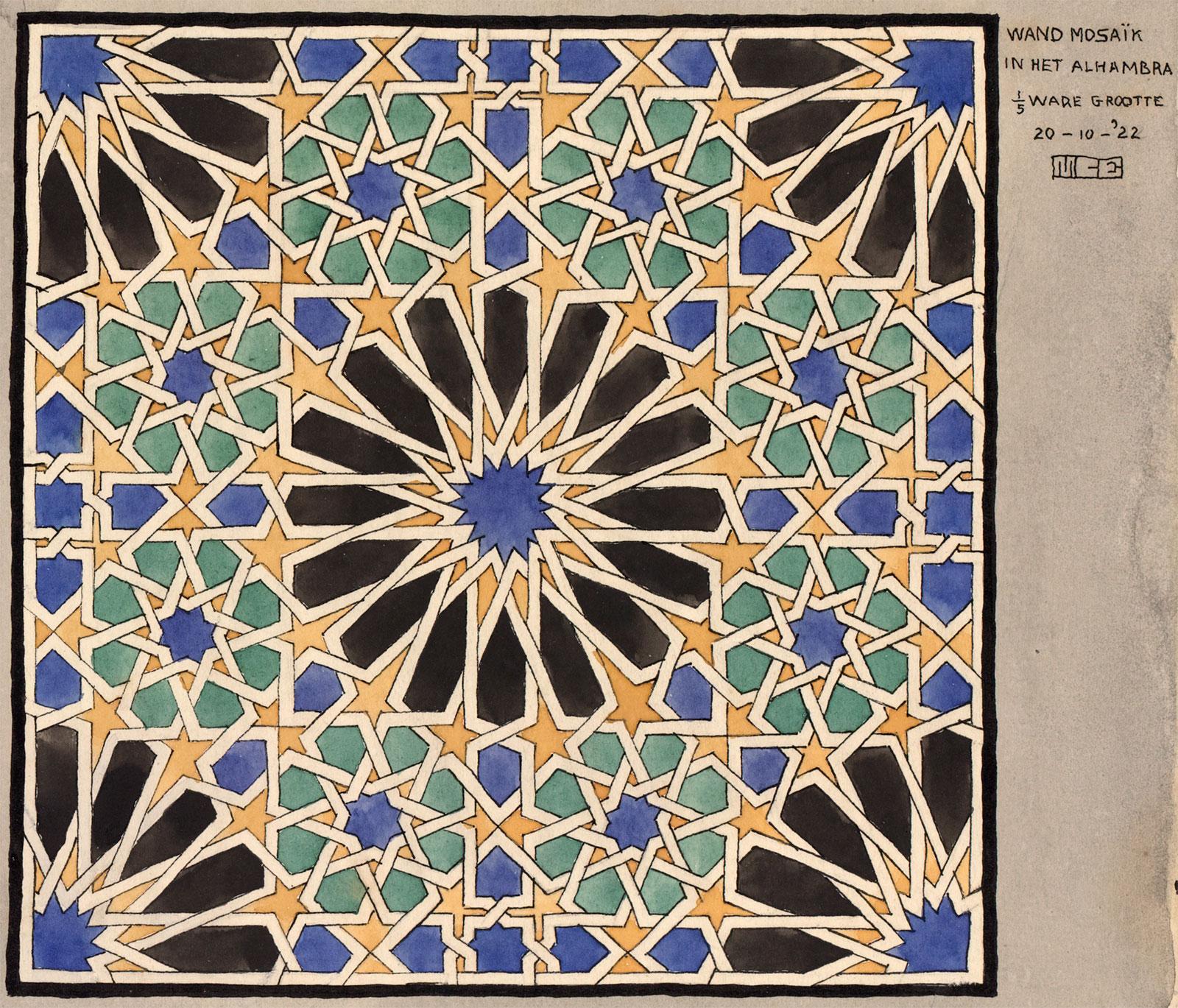
M.C. Escher, Wall mosaik in the Alhambra, drawing, 20 October 1922
Escher’s visits to the Alhambra and the Mezquita led to clear similarities between his work and Islamic geometric art. In Islamic patterns, shapes evolve into complex abstract forms, often with floral or botanical motifs. Escher and the long Islamic cultural tradition use the same systems of symmetry to create tessellations. Mathematical knowledge is not strictly necessary for this. As Eric Broug demonstrates in his publications on Islamic geometric patterns, a compass and a ruler are sufficient to construct patterns oneself. He shows, step by step, how such designs can be built up from simple basic geometric shapes.****
Escher also discussed his fascination with these patterns with his half-brother Berend, who was a professor of geology, mineralogy, palaeontology and crystallography at Leiden University. Berend advised him to study the Zeitschrift für Krystallographie und Mineralogie (founded in 1877). Although the material in the journal proved too theoretical and too difficult for Escher, there was one article that did intrigue him: Über die Analogie der Kristallsymmetrie in der Ebene (1924) by the Hungarian professor George Pólya, who lived in Zurich. In this article, Pólya described what a tessellation is, a definition that Escher subsequently adopts in his notebook. Escher also copied the illustrations with which explained the various systems for creating tessellations.*****
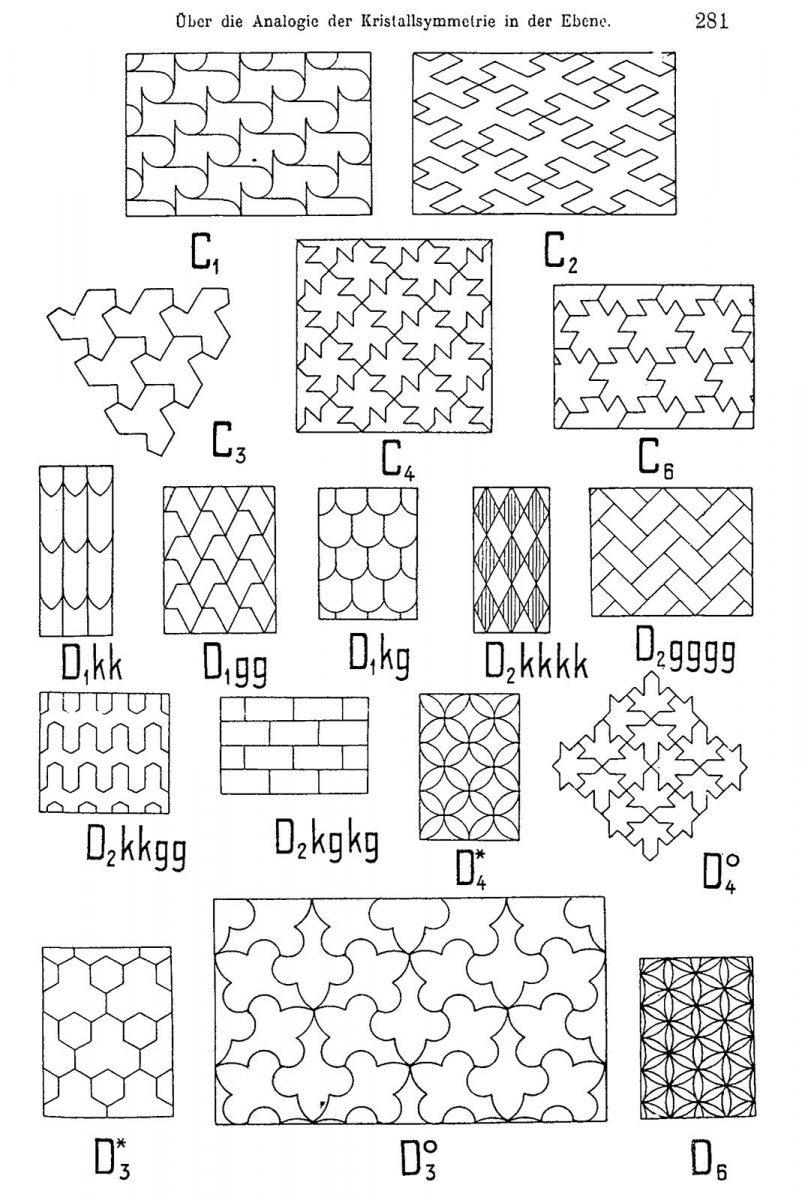
The 17 different systems of George Pólya
Optical imagination and illusion
Inspired by Spanish-Islamic geometry and Pólya’s systems, Escher puts his own spin on tessellations. He opts for shapes featuring living creatures. A year after his visit to the Alhambra and the Mezquita, he made three prints in which tessellations take centre stage. These go beyond his earlier experiments with patterns by exploring the limits of optical imagination and illusion. Such as Development I (1937) , for which he clearly used Regular division of the plane, no. 14 [Reptile] (1937) as an inspiration.
![<p>Regular division of the plane, no. 14 [Reptile], India ink, pencil, watercolour, November 1937</p>](/_next/image?url=https%3A%2F%2Fprdzoomst01.blob.core.windows.net%2Fescher-production-silverstripe-assets-public%2FUploads%2FImageBlock%2F2011c0631305.jpg&w=3840&q=75)
Regular division of the plane, no. 14 [Reptile], India ink, pencil, watercolour, November 1937
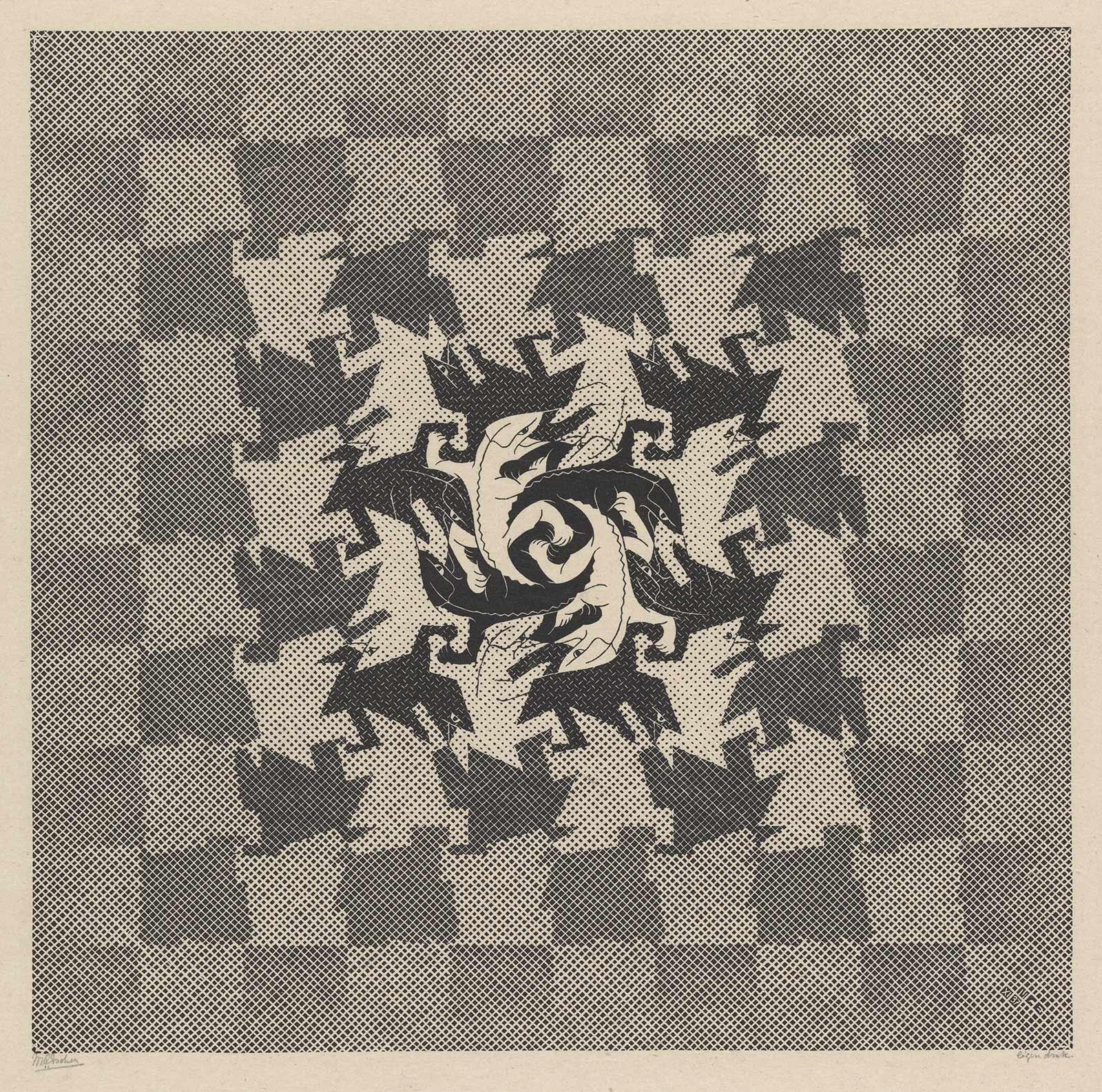
Development I, woodcut, November 1937
Escher’s later, world-famous print Reptiles (1943) is also clearly based on a tessalation drawing. In the print, reptiles crawl out of the two-dimensional pattern as three-dimensional creatures and move across the desk. After making a circuit, they return to the flat surface from which they emerged. In this way, Escher depicts a continuous cycle. The seemingly boundless pattern of the tessalation thus takes on an extra dimension: an endless cycle in which the reptiles emerge from the tessalation time and again, only to disappear back into it.
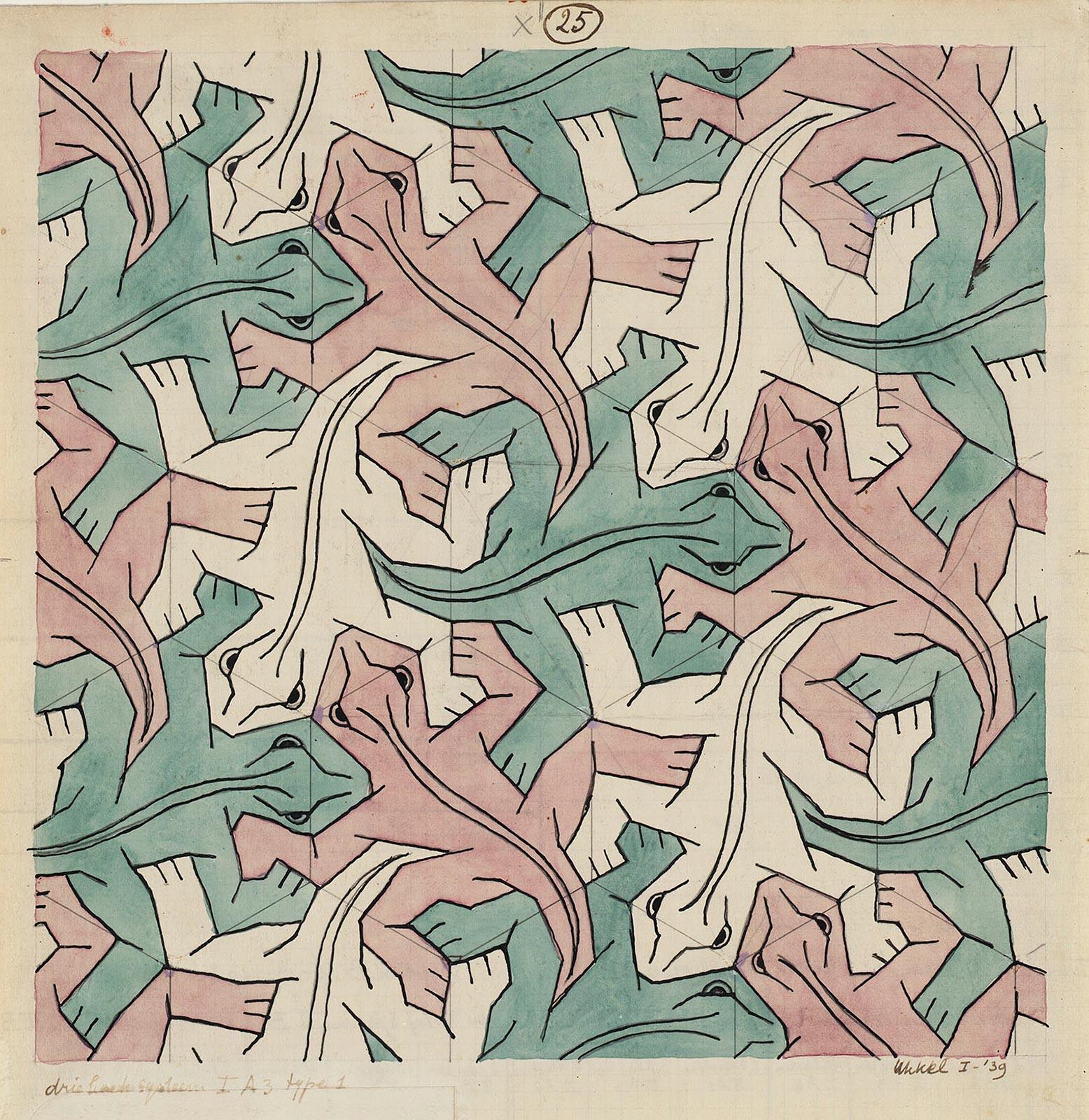
Regular division drawing with lizards, no. 25, India ink, pencil and watercolor, January 1939
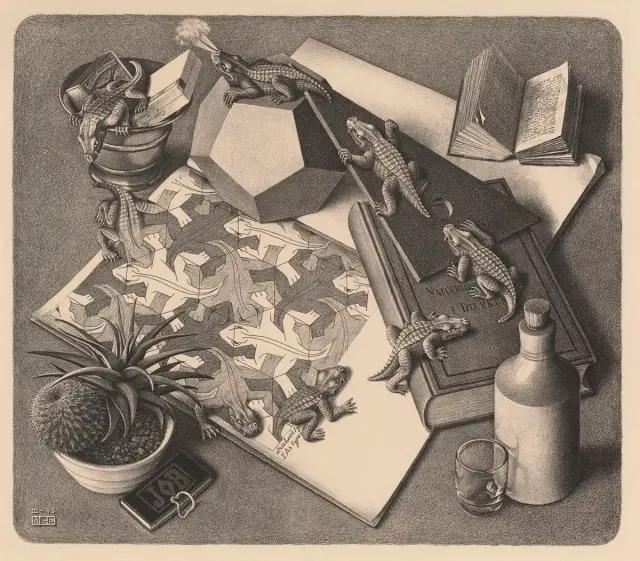
M.C. Escher, Reptiles, lithography, March 1943
Many of Escher’s drawings depicting regular divisions of the plane would serve as the foundation for prints that later gained world fame, such as Day and Night (1938), Sky and Water I (1938), and his magnum opus, the Metamorphosis (I, II, and III) (1937, 1939-1940, 1967-1968).
The geometry that inspired Escher continues to inspire artists and makers to this day. As becomes evident in the exhibition Escher & Islamic Art: 20 Perspectives (on view June 10- November 1, 2026 at Escher in The Palace). But why is geometry so vital to so many artists, people, and visual idioms?
Conveying meaning
One possible explanation for this is that geometry is a language that many people understand intuitively. In art, figurative representations often play an important role in conveying meaning. In Islamic art, this is achieved through surface patterns, such as mosaics and geometric motifs. These can be highly expressive. Islamic geometry is perceived by many as powerful because it appeals directly on a visual and emotional level. In Islamic cultures, geometric patterns are not merely decorative; they can also be used to convey meaning - including religious ideas - and emotion. Moreover, specialised knowledge of art is not necessarily required to appreciate it. Geometric art can invite people to look, experience and assign their own meaning to what they see. In doing so, the forms sometimes seem to establish a direct connection with the viewer, without the need for extensive explanation.******
Perhaps this deep connection of geometry to our feelings and emotions, rather than our reason, is why Escher described his lifelong discovery of tessellations as “some sort of primal urge”: a primal urge that is inextricably linked to being human.*******
Sources
[*] Robert Hillenbrand, Islamic Art and Architecture (Thames and Hudson, 1999), 167-195
[**] Micky Piller, “Escher Visits Andalusia,” in Escher Meets Islamic Art (exhibition catalogue) (THOTH Publishers, 2013)
[***] Piller, Escher meets Islamic Art, 15
[****] Eric Broug, “Escher and Islamic Geometric Design,” 2013, 20
[*****] Wim Hazeu, M.C. Escher. Een biografie (Meulenhoff, 1998), 248
[******] Wendy Shaw, “Islamic Geometries: Spiritual Affects Against a Secularist Grid”, International Journal of Philosophy and Traditions 61, (2022), 41
[*******] M.C. Escher, Travel diary (31 mei 1936), 76
More Escher today
4 July 2026
A Remarkable Collaboration
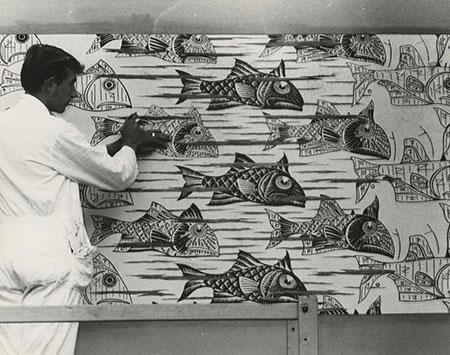
Painting apprentice Huug Vooys was 19 when he was invited to take part in an exceptionally special project: a mural no less than 48 metres long in the main PTT building, the post office on Kerkplein in The Hague. The design was by none other than M.C. Escher, who himself noted that he had possibly received "a most delightful commission" from the PTT. The large work was realised, but Escher did not execute the design himself - the honour fell to Huug Vooys.
20 May 2026
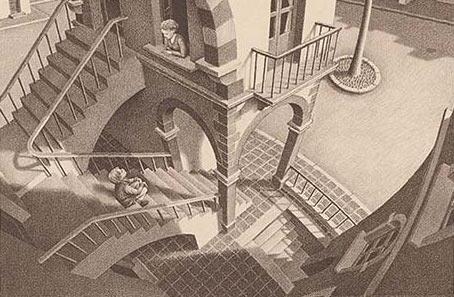
Perfect perspectives in Up and Down
Escher’s fascination with the possibilities of perspective is already evident in his early prints. In these works, he combines the rules of classical perspective with an extreme vantage point. Later, he began to experiment more and used the rules of perspective to mislead viewers. In these works, the perspective lines are straight, but Escher realised that, in actuality, a curved line corresponds more closely to what our eyes see. In Up and Down, he achieves perfection in the application of curved perspective.
31 January 2026
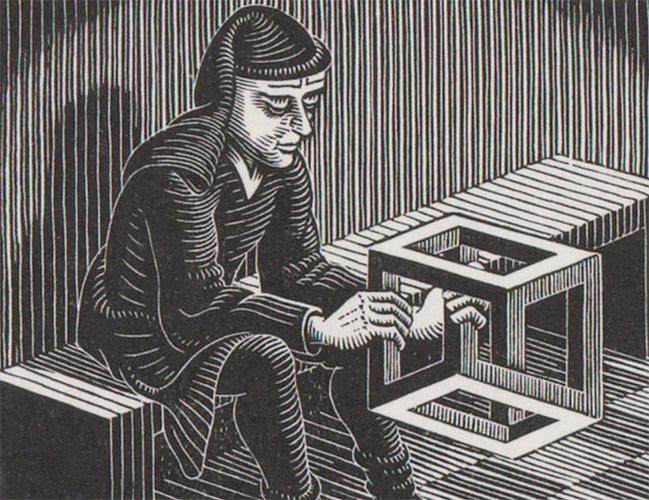
Fool the eye
There has always been great interest worldwide in M. C. Escher's work. Articles about him and his art often speak of 'optical illusions’ and his work is almost automatically associated with that term. Understandable, even though the relationship between optical illusions and Escher's work differs from how optical illusions are generally explained.